What Competitor Reviews Really Tell You
Competitor reviews are free market research. Learn how to read middle ratings, spot repeated complaints and turn what you find into a stronger offer.
Mohamad Mouaz
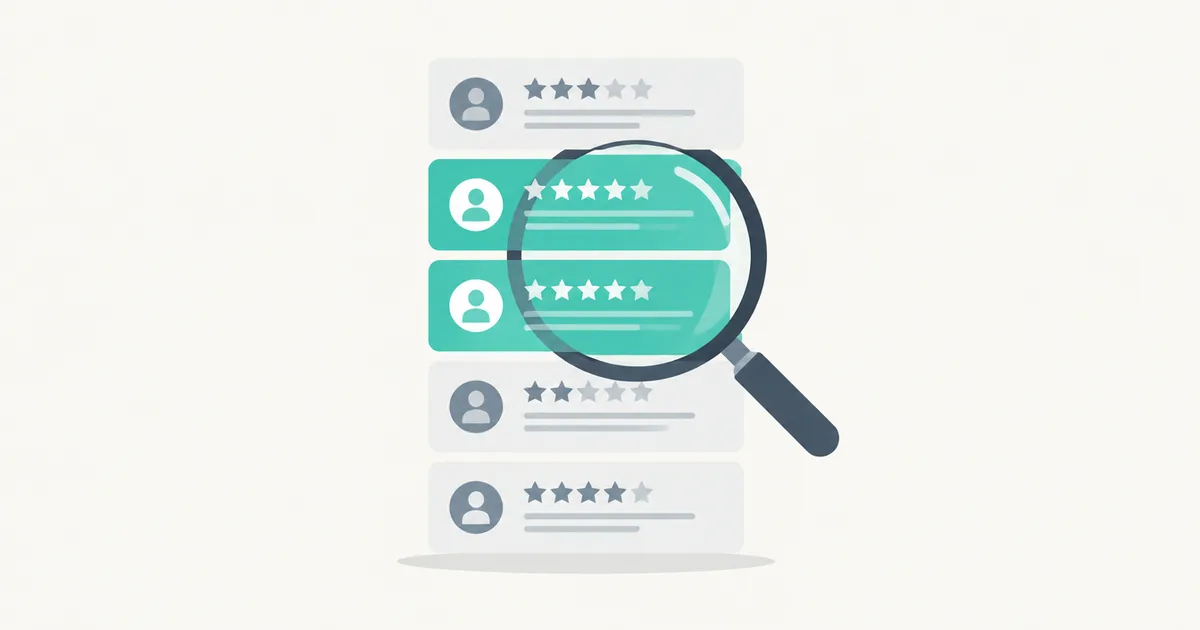
If you want to know what customers really think about a product category, skip the marketing pages and read the reviews. Reviews are the closest thing you will get to a free focus group, and your competitors have already run it for you.
The trick is knowing how to read them. Most people skim the star rating and move on. The useful material is in the details, and it takes about an hour to learn what is hiding there.
Start with the middle, not the extremes
Five star reviews tell you what people like, but they are often short and polite. One star reviews tell you what went badly wrong, but they can be angry and unfair. The most honest reviews usually sit in the middle, at three and four stars.
Those reviewers liked the product enough to keep it and cared enough to write. They tend to say things like "great, but the strap broke after a month" or "works well, though setup was confusing." That "but" is where the opportunity lives.
Look for the same complaint, again and again
One complaint is an opinion. The same complaint twenty times is a pattern. Read through a few dozen reviews for the leading products in your category, and keep a simple tally of what keeps coming up.
Common themes include sizing that runs small, packaging that arrives damaged, instructions that nobody can follow, a part that wears out early, or a smell people cannot stand. Each repeated complaint is a gap that a better product or a better listing could fill. The same idea sits behind finding unmet customer needs.
Pay attention to the words customers use
Customers describe products in their own language, and that language is gold for your own listing and ads. If buyers keep saying "sturdy" or "easy to clean" or "fits in a small bag," those phrases tell you what they care about.
Copy the meaning, not the exact sentences. When your listing speaks in the same terms that buyers already use, it feels familiar and trustworthy. It also helps people find you, because those are the words they type into search.
Separate product problems from service problems
Not every bad review is about the product. Some are about late delivery, poor support or a confusing return process. These matter too, but they point to a different opportunity.
If the product is loved but the service is hated, you may not need a new product at all. You might win by offering the same thing with faster shipping and a friendlier returns policy. Knowing which kind of problem you are looking at stops you from solving the wrong one.
Check who is writing
Ask who the reviewers are. Are they beginners or experts? Are they buying for themselves or as gifts? What are they using the product for?
You will often find uses the seller never planned. A tool built for one job gets bought for another, and the reviews say so. Those unexpected uses can point you to a niche that the main competitors are ignoring. This ties in with the thinking in finding untapped niches first.
Be wary of fake and inflated praise
Not every review can be trusted. Look for signs of low quality praise: many reviews posted on the same day, vague comments that could apply to any product, and glowing text that reads like an advertisement.
You do not need to prove which ones are fake. You just need to weight the detailed, specific reviews more than the generic ones, and look at trends instead of single comments. A product with lots of detailed complaints and a suspiciously perfect average deserves a second look.
Turn what you learn into action
Reading is only useful if it changes a decision. After your review session, write down three things: the top complaint across competitors, the top thing customers love, and one thing nobody seems to offer.
Those three lines are the start of a product brief. The complaint is what you fix, the love is what you must not lose, and the missing thing is what could make you different. If you are still deciding whether the product is worth pursuing, the competitor research approach can help you compare options.
Make it faster
Reading reviews by hand is worth doing for your finalists, but it is slow for a long list of ideas. TrendHunterNeo looks at live trend data and competitor storefronts together, so you get a quick read on a category before you decide where to spend your reading time.
Use a tool to narrow the field, then read the real reviews yourself for the products that survive. The human reading is where the best ideas show up.
The takeaway
Competitor reviews are free, honest and sitting in plain view. Read the middle ratings, count repeated complaints, borrow the customers' language and separate product problems from service problems. An hour of this will teach you more about your market than a week of guessing.
Find your next winning product with
TrendHunterNeo
AI-powered research that scans live trend data and competitor storefronts, then returns a profitability verdict in under a minute. Validate a product idea before you spend on inventory or ads.